
Blog Details
- Member
- January 1, 2026
From Stories That Explain to Stories That Think
How Srijan Sanchar Is Redefining Learning for an Uncertain World
Introduction
Storytelling has always been one of humanity’s most powerful learning tools. From classrooms to corporate training rooms, stories are used to explain complex ideas, improve recall, and create emotional connection. In most education systems, storytelling is treated as a supportive technique—something added to knowledge to make it more engaging or memorable. While effective, this approach assumes that knowledge itself is already settled and that stories merely help communicate it.
Srijan Sanchar challenges this assumption at its root. It treats story not as a teaching aid layered on top of knowledge, but as a structural system through which knowledge itself is formed, tested, and refined. In a world shaped by uncertainty, rapid change, and complex interdependencies, learning cannot remain linear or purely retrospective. Srijan Sanchar reframes pedagogy so that learners experience how understanding actually evolves—through exploration, constraint, probability, and convergence.
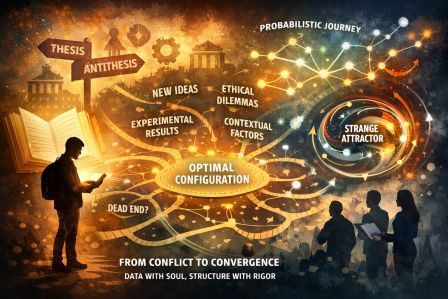
What makes this approach distinctive is its rejection of binary thinking. Traditional pedagogy often frames learning as a contest between opposing ideas: right versus wrong, old versus new, thesis versus antithesis. While neat and orderly, this framing misrepresents how real-world knowledge progresses. In practice, progress emerges from multiple competing ideas operating simultaneously—experimental anomalies, alternative models, ethical considerations, and contextual realities all exert pressure at the same time. Srijan Sanchar replaces binary opposition with a multi-option conceptual field, allowing learners to explore a network of possibilities rather than a single debate.
In this framework, progress does not occur because one idea “wins.” Instead, it happens through conceptual sampling—a process in which the most coherent and useful elements from several ideas are selectively integrated. The outcome is an optimal configuration: a solution that works best under current constraints. Importantly, this configuration is not treated as final truth, but as a stable and temporary coherence that remains open to revision as conditions change. Learners thus internalize a realistic understanding of knowledge as provisional and adaptive rather than absolute.
Srijan Sanchar also reconceptualizes opposition itself. Instead of viewing polarity as a fixed conflict that must be resolved, it treats tension as a productive space created by competing constraints. Drawing from complexity science, moments of synthesis behave like strange attractors—they pull diverse ideas into temporary order without eliminating complexity. These moments stabilize understanding just long enough to be useful, while also preparing the ground for future disruption and innovation. Progress, in this view, comes not from eliminating uncertainty but from organizing it responsibly.
Within this learning environment, traditional opponents are reframed as participants in a shared problem space. Each perspective contributes a non-negotiable constraint that must be respected. A solution is considered valid only if it satisfies all critical constraints simultaneously—logical, empirical, ethical, and contextual. Convergence is therefore driven by necessity and coherence, not authority, persuasion, or rhetorical dominance. Learners develop the capacity to integrate rather than polarize.
A defining feature of Srijan Sanchar is its treatment of thinking as a probabilistic journey. Movement from one idea to another is shaped by likelihood rather than certainty, influenced by evidence, experience, training, and culture. Some paths advance understanding, while others lead to dead ends. Crucially, these dead ends are not treated as failures. They demonstrate that outcomes were not inevitable, preserve intellectual humility, and reveal the real cost of arriving at robust knowledge. Learning becomes honest to how discovery actually unfolds, complete with false starts, revisions, and persistence.
This honesty extends to the emotional and social dimensions of learning. Meandering, uncertainty, disagreement, and delayed recognition are acknowledged as normal features of innovation. By making these dynamics visible rather than hidden, Srijan Sanchar prepares learners for the realities of creative and professional life, where clarity often emerges late and effort precedes recognition.
At the same time, this is not an unstructured or intuitive approach. Srijan Sanchar responds to a central crisis of modern education: the coexistence of abundant information with fragmented meaning. Stories in this methodology are designed to carry epistemic weight. They bind abstraction to human struggle while maintaining precision, causality, and cross-disciplinary rigor. Clear design frameworks, such as structured alignment models, allow educators to intentionally engineer learning experiences rather than relying on improvisation.
Perhaps most importantly, Srijan Sanchar is inherently forward-looking. Learners are trained not only to understand past knowledge but to anticipate future convergence points, evaluate emerging options under uncertainty, and exercise judgment before consensus forms. Education shifts from memorization to responsible decision-making, equipping people to act wisely in situations where answers are incomplete and consequences are real.
The impact of this approach is wide-ranging. In education, it prepares students to navigate evolving disciplines rather than static syllabi. In leadership and policy, it develops judgment under uncertainty. In innovation and research, it normalizes exploration, failure, and convergence. In the age of AI, it aligns human learning with probabilistic reasoning while preserving meaning, ethics, and responsibility.
Srijan Sanchar does not simply tell stories about knowledge. It equips learners to navigate the living system of knowledge itself—with rigor, humility, and foresight. In an era where certainty is rare and complexity is unavoidable, this may be one of the most important evolutions in how we think about learning.